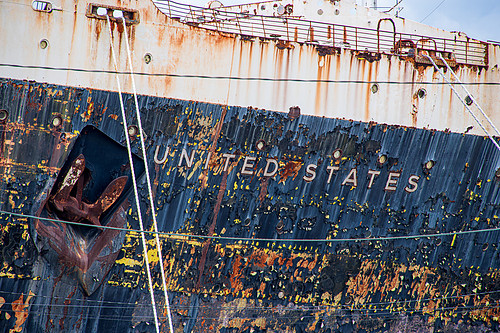
Through vivid orange rust, peeling black topcoat ironically revealing olive-yellow anti-corrosion primer, and pale blue streaks of aluminum oxide from corroded aluminum fittings attached to her steel hull, the no-longer-quite-white ship’s name stands out.
Six years ago, I took the opportunity to photograph the ocean liner S.S. United States alongside a dock in Philadelphia. I captured several images to illustrate what had become of this iconic ship of steam, which I first read about as a young boy in the 1960s; in a book from my U.S. naval officer father’s bookshelf.
Even after years lashed to the dock, she still exuded a sense of speed and the power of steel and steam to cross the restless waves.
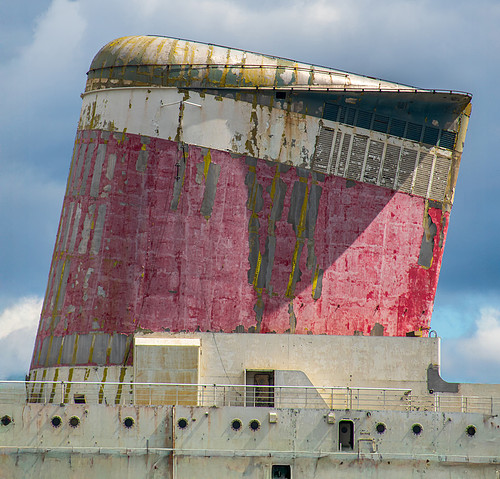
When launched in 1951, her sleek form and patriotic livery deliberately evoked a sense of national identity. Indeed, in the aftermath of World War II, she was meant for potential use as a troop transport, too. After plying the Atlantic for seventeen years, the advent of much faster jet travel led to the end of her service in 1969. Ironically, to this day, she holds the Blue Ribband record as the fastest ocean liner to cross the Atlantic in either direction. After she languished for decades amid ownership changes and unrealized restoration plans, oceangoing tugs towed her away in early 2025 for preparations to be sunk as an artificial reef.
The S.S. The United States was still new when Lamont Buchanan’s classic 1956 book Ships of Steam was published, featuring fascinating stories and images of the Queen Mary, Normandie, Victory ships, Andrea Doria, Titanic, and many others. Buchanan dedicated six pages to “the fastest and largest passenger liner ever built in America, fittingly called the United States.” She is still the largest ocean liner entirely constructed in the United States, the once-majestic icon of sadly atrophied American shipbuilding prowess.
In the decades since the 1950s, we’ve lost much of the engineering capability, industrial capacity, and national pride Buchanan so enthusiastically described. “The U.S. has an astonishing lack of maritime capacity,” according to Open Markets Institute transportation policy analyst Arnav Rao, writing in The Atlantic’s “How America Lost Control of the Seas.”
The numbers are sobering. “U.S. shipyards were building 5 percent of oceangoing commercial ships in the 1970s,” according to Lieutenant Commander Frederick “Andy” Cichon, U.S. Navy (Retired), writing in the U.S. Naval Institute Proceedings. “By 2016, U.S. shipbuilding had contracted by more than 85 percent, and the number of U.S. shipyards large enough to build oceangoing vessels had dropped by more than 80 percent. By 2023, the U.S. market share had dropped to 0.13 percent.” This from the people who literally built the “United States,” including, among other accomplishments, transcontinental railroads and interstate highways across the vast continent of North America. But perhaps there is hope; Cichon’s article is entitled “The Next Great Era in U.S. Shipbuilding.”
But it is ironic, isn’t it, that the United States began rusting away dockside the same year Neil Armstrong said “one small step for a man, one giant leap for mankind” as he set foot upon the Moon. We’ve not returned in over half a century.
The state of a ship named the United States seems emblematic of a larger problem with its namesake. In Breakneck, his book on the relationship between China and America, technology analyst Dan Wang asserts that America has, over the decades, “transformed into a lawyerly society” that seems to excel at “blocking everything, both the good and the bad,” while China has become a burgeoning “engineering state, relentlessly pursuing megaprojects” of the kind America once tackled.
Wanting something more than a simple print or run-of-the-mill frame, I assembled an appropriately “aged and rusted” old metal frame to house the image, wall art humbly offered as commentary on the state of our nation, industry, society, democracy, our republic (can we keep it, as Benjamin Franklin is said to have asked?). Our culture and way of life.
I call it Metaphor.
But at the same time, and perhaps more importantly as we begin to celebrate our nation’s semiquincentennial, the art features a bold if weathered glimmer of optimism about the future of these United States. Right there in the middle of the image.
Have comments? Reach me directly on the contact page.
By the way, Metaphor, my one-of-a-kind limited edition fine art archival pigment print in a 36"x24” “aged” metal frame is available now to buy.
